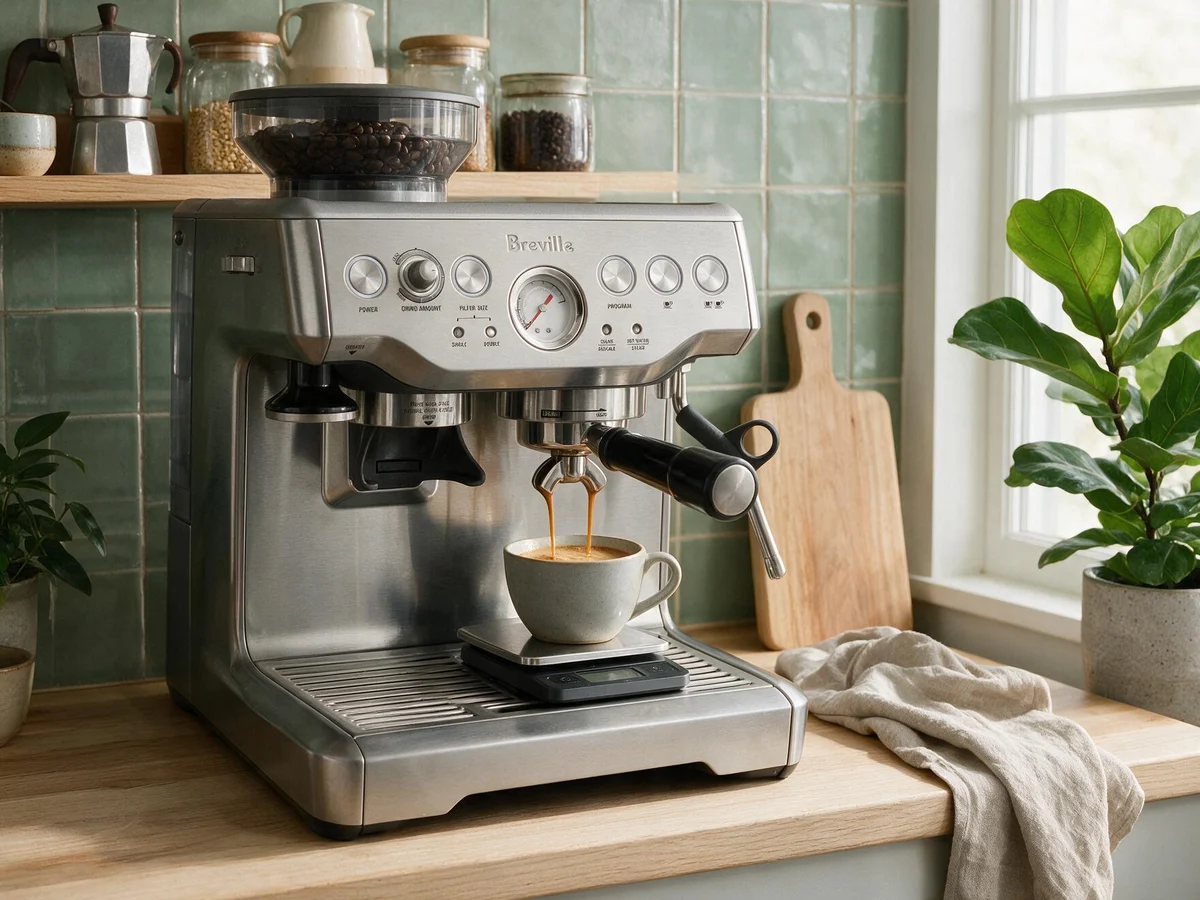
For a balanced double espresso on the Breville Barista Express, start with 18 grams in, 36 grams out, in 25–30 seconds. Then adjust the grinder—not every setting at once—until the shot tastes sweet and balanced.
Barista Express recipe at a glance
| Basket | 2-cup single-wall basket |
|---|---|
| Dose | 18 g |
| Espresso yield | 36 g |
| Beverage ratio | 1:2 |
| Temperature | Default 200°F / 93°C |
| Shot time | 25–30 seconds |
| Pressure | 9-bar extraction after low-pressure pre-infusion |
Breville’s current espresso recipe recommends 19 g in, 38 g out, in 20–30 seconds. The Barista Express manual gives a 15–18 g range for its two-cup basket and a 25–35 second correct-extraction window. The 18 g / 36 g baseline stays within the basket guidance and matches the 1:2 ratio commonly used by specialty baristas.
Before you dial in
- Use coffee with a known roast date and keep it sealed between uses.
- Use the single-wall basket for freshly ground coffee. The dual-wall basket is more forgiving for older or preground coffee but gives you less direct control.
- Use a scale that fits beneath the cup and reads to 0.1 g if possible.
- Warm the locked-in portafilter and cup, then purge the group head before dosing.
How to pull the shot
- Preheat fully. Turn on the machine, lock in the empty portafilter, warm the cup, and give the group head a short water purge.
- Weigh an 18 g dose. Grind into the two-cup single-wall basket. Do not treat a numbered grinder setting as universal; burr calibration, coffee, roast, and age all change the answer.
- Distribute evenly. Break up clumps and level the grounds before tamping. An uneven bed creates fast and slow channels.
- Tamp level. Use consistent, firm pressure. A level puck matters more than chasing an exact force number.
- Lock in and brew immediately. Place the cup and scale underneath, tare, start the shot, and start the timer as you press the two-cup button.
- Stop at 36 g. Use manual control if necessary so the programmed volume does not decide the yield for you. The scale may coast another gram after stopping.
- Taste before changing anything. Record dose, yield, time, and flavor. Make only one adjustment for the next shot.
How to dial in the grinder
| Result at 36 g yield | Likely cause | Next move |
|---|---|---|
| Under 25 sec; sour, thin, pale | Water flows too easily | Grind finer |
| 25–30 sec; sweet and balanced | Good starting extraction | Keep the setting |
| Over 30–35 sec; dry, bitter, slow | Too much resistance | Grind coarser |
| Sprays, runs unevenly, tastes both sour and bitter | Channeling or uneven puck prep | Improve distribution and level tamp |
After moving the grind dial, purge a small amount of coffee so the next dose reflects the new setting. If the external dial reaches its limit, the Barista Express also has an adjustable upper burr; follow the machine manual and change one step at a time.
Adjust yield by taste
- Sour after the time is correct: try a slightly longer yield, such as 18 g in and 40 g out.
- Bitter or hollow after the time is correct: try stopping earlier, such as 18 g in and 32–34 g out.
- Dark roast tastes harsh: a lower temperature setting or shorter yield can help.
- Light roast remains sharp: a slightly higher temperature or longer yield can improve extraction.
Common Barista Express mistakes
- Using the pressure gauge as the only measure of a good shot. Yield, time, and taste give more useful information together.
- Changing dose, grind, temperature, and yield simultaneously. You will not know which change helped.
- Leaving old grounds in the grinder or basket. Stale coffee and retained grounds make dialing in unpredictable.
- Ignoring water and scale. Espresso machines need water that tastes good and is compatible with the manufacturer’s maintenance guidance.
Espresso uses beverage yield rather than all the water in the tank, which is why its 1:2 ratio differs from drip coffee. Read our coffee ratio guide for the distinction, and our water guide before changing the machine’s water source. For a concentrated stovetop cup without an espresso machine, use our Moka Pot guide.