Molex at Work
Better coffee for
teams that build.
Specialty coffee roasted in Miami Lakes and delivered to your office — for businesses who want what they hand their team, and their customers, to be genuinely good.
We are taking three to five pilot accounts this season.
Most offices never chose their coffee.
They inherited it. A can that arrived with the brewer. A pod carousel somebody set up in 2021. A standing order nobody has looked at since. It is not anyone’s fault — coffee is rarely anyone’s job — but it does mean the thing your team touches every single morning is the one thing nobody actually decided.
Coffee is fruit, and it goes stale like fruit. What reaches you from a roaster carries the place it grew: a named valley, a named cooperative, a process somebody chose on purpose, and a roast date you can read. What reaches you in a can was roasted dark enough to survive months in a warehouse, because surviving months in a warehouse was the job.
Nobody on your team has to become a coffee person for this to land. The first morning someone stops and says wait, what is this? is usually the whole argument.
Sealed in 12 oz bags, on purpose
A five-pound bag opened on the first of the month is flat by the fifteenth, and considerably sooner than that if it is ground. We deliver in sealed 340 g bags on a weekly or biweekly schedule, so the last cup of the month tastes like the first — and so nobody has to find somewhere to store a month of coffee at once.
Everything is roasted in small batches in Miami Lakes, days before it reaches you rather than months before it reaches a warehouse.
What you get
It is a setup, not a delivery.
Anyone can put a box of coffee on your counter. The difference between good coffee in an office and good coffee in a bag is everything underneath.
- A look at how much coffee you actually go through, and what you are brewing on.
- A coffee matched to that equipment and that room — not to a catalogue.
- Whole bean, or ground to your method. Refill pods included, if you are keeping the machine you have.
- A delivery schedule set to how fast you drink it, not to a billing cycle.
- A recipe card for your brewer, written in plain numbers.
- Fifteen minutes with whoever makes the coffee, so it gets made the same way twice.
- A cleaning checklist. A clean brewer is most of the battle and nobody ever gets told that.
- Filters and supplies restocked alongside the coffee where it makes sense.
- A quality check every so often, and a rotation whenever the room wants a change.
- One phone number, and it is the roaster’s.
Where the coffee goes
A break room and a front counter are two different problems. We size them differently, and most places turn out to need both.
The break room
Sized by how many people on your team actually drink coffee. Ten drinkers run through roughly sixteen bags a month.
There is room back here for a grinder and for somebody on the team to take an interest. In our experience somebody always does, and the coffee gets better for it.
The front of house
Sized by how many people come through the door. A showroom seeing thirty visitors a day, with four in ten taking a cup, runs about ten bags a month.
Out here consistency beats ceremony. Batch brew or an airpot, so what you hand a client is good whether or not the person who cares about coffee came in today.
The lineup
What we are pouring right now
Molex carries two or three coffees at a time. That is not a shortcoming we are working around — it is how a small roastery keeps everything on the shelf fresh enough to be worth buying.
Venture Series
Scale Together
Costa Rica – Santa Maria Dota Tarrazu
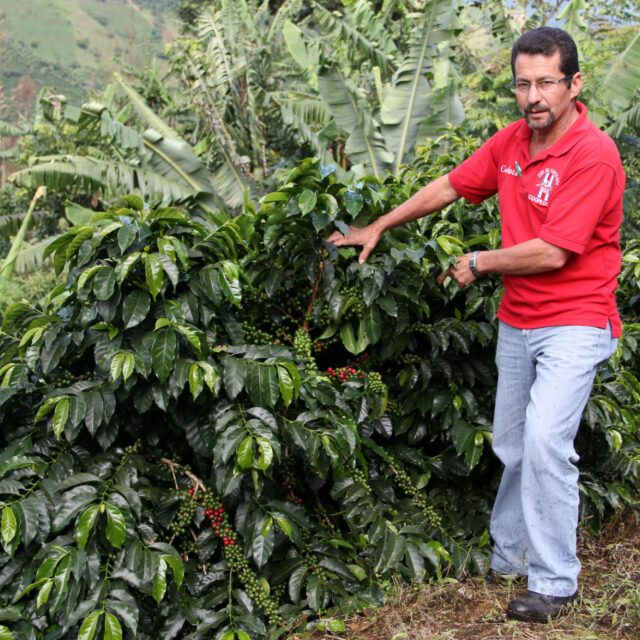
Coopedota was founded in 1960 by 96 growers in a valley with no mill of its own, who until then sold their cherry to resellers at whatever price was offered. More than 800 members now share one wet mill in Santa Maria de Dota and…
$23.00 a 12 oz bag · $20.70 on a standing order

Core Coffee
The Night Shift Blend
Midnight Espresso
Some of the most important work happens after the visible day ends: the adjustments, the preparation, the quiet problem-solving that makes tomorrow possible. This blend was built for that shift and for the equipment it usually…
$19.00 a 12 oz bag · $17.10 on a standing order
What it costs
At 13 g a cup — a standard dose for an 8 oz cup of drip — a 340 g bag makes about 26 cups. Which puts premium specialty coffee somewhere most people do not expect it:
| Molex, on a standing order | $0.66–$0.80 |
|---|---|
| Premium pods | $0.80–$1.00 |
| Sending someone to the café | $3.50–$6.00 |
At two cups a day that is about $1.50 per person — less than a quarter of one café run, for coffee nobody has to apologise for.
The standing order
Four bags a month or more, on a set schedule: 10% off every bag. Every business account clears four bags — three coffee drinkers will do it — so in practice this is simply the business price.
Billed monthly through Stripe. Nothing to sign, and you can move the quantity up or down whenever your consumption changes.
Delivery
From Weston down to Doral, we bring it ourselves for $5. Miami Lakes sits in the middle of that corridor, so it is a short drive — and we would rather hand it to you than hand it to a carrier.
Everywhere else ships at cost. You get the same coffee and the same recipes; what you do not get is somebody standing in the room looking at your brewer.
Weston · Southwest Ranches · Davie · Cooper City · Pembroke Pines · Miramar · Hialeah Gardens · Hialeah · Miami Lakes · Medley · Doral
Coffee as the gift
A closing, a launch, a team that just finished something difficult, or the end of the year. We build boxes to order rather than keeping four permanent ones on a shelf: an approachable coffee and a brew guide, two coffees and a tasting notebook, or something assembled around whatever the occasion actually is.
Tell us the headcount and the budget and we will come back with options. If you would rather let people choose for themselves, gift cards are on the site.
Getting started
How a pilot works
- One
A fifteen-minute call
What you have, what you go through, and what annoys you about it.
- Two
A look at the space
We come and see it. Outside the delivery corridor, photos do the job.
- Three
Two weeks of coffee
A real schedule, a real recipe, real deliveries — so the room is judging the actual thing and not a sample.
- Four
A standing order, if it earned one
Four bags a month or more at 10% off, delivered weekly. Nothing to sign.
There is no contract at any stage. If two weeks of it does not win the room over, that is genuinely useful information and we part on good terms.
Tell us about the room
The more of this you fill in, the closer the first answer gets to a real quote instead of another round of questions.